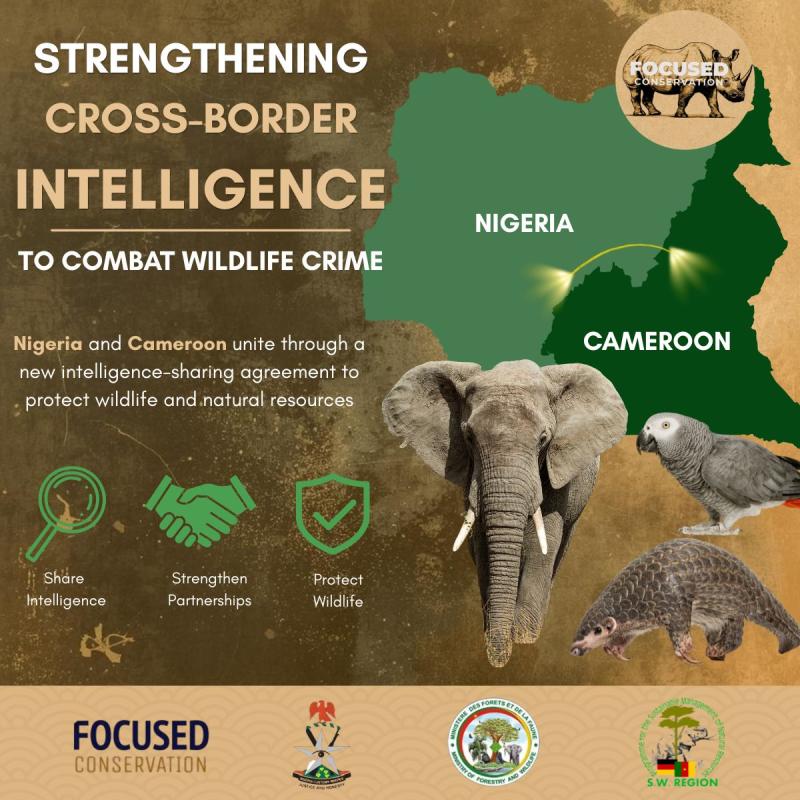
On April 8, 2026, Focused Conservation supported a significant step forward in the fight against transnational wildlife crime in West and Central Africa. Focused Conservation Technical Advisor Danny Murphy, alongside Mani Anuhu, traveled to Cameroon to meet with senior officials from the Cameroon Ministry of Forestry and Wildlife and the Program for the Sustainable Management of Natural Resources.
The purpose of the engagement was to formalize a cross-border intelligence-sharing agreement between Nigeria and Cameroon, two countries that play a critical role in regional wildlife trafficking routes. The meeting resulted in a successful agreement, with a Memorandum of Understanding (MOU) and Standard Operating Procedures (SOP) signed by both parties. The agreement is now awaiting final ratification from each country’s Minister of Environment.
This milestone reflects the growing recognition that wildlife crime is not confined by borders and requires coordinated, intelligence-led responses. The collaboration is expected to significantly enhance the ability of enforcement agencies in both countries to share real-time intelligence, coordinate operations, and disrupt trafficking networks operating across the region.
Special recognition is extended to Hani Gue and Danny Murphy, whose efforts were instrumental in building the relationships necessary to make this agreement possible.
A Critical Region for Wildlife Crime
Both Nigeria and Cameroon are considered key transit and source countries for wildlife trafficking in Africa. According to international reporting, West and Central Africa have become major hubs for the illegal movement of wildlife products, with trafficking routes linking Africa to markets in Asia.
Commonly trafficked wildlife products in the region include:
- Ivory from elephants
- Pangolin scales, with Africa now the primary global source
- Live primates, including chimpanzees and other endangered species
- Reptiles and exotic birds for the pet trade
In addition to fauna-related crimes, illegal exploitation of natural resources such as high-value timber species (including rosewood) and illicit mining activities continue to fuel environmental crime networks.
Estimates from global enforcement and conservation organizations suggest that wildlife trafficking generates billions of dollars annually, often overlapping with other forms of organized crime, including narcotics and arms smuggling and human trafficking.
Building on Past Cooperation
Nigeria and Cameroon have previously collaborated on enforcement actions targeting cross-border wildlife crime. Joint intelligence efforts have contributed to seizures of pangolin scales and ivory shipments moving through regional ports and border crossings. These efforts have demonstrated the effectiveness of coordinated action, but also highlighted the need for more structured and sustained information-sharing mechanisms.
The newly signed MOU/SOP aims to address these gaps by establishing formal channels for communication, intelligence exchange, and operational coordination between the two countries.
Strengthening the Front Line
The importance of this agreement cannot be overstated. By improving intelligence flow at a critical border region, authorities will be better equipped to identify trafficking networks, intercept illegal shipments, and protect vulnerable species and ecosystems.
Focused Conservation remains committed to supporting partners across Africa by strengthening capacity, fostering collaboration, and advancing innovative approaches to combat wildlife and environmental crime.
This agreement marks another step forward in building a united front against those who exploit natural resources and a stronger foundation for protecting Africa’s biodiversity for generations to come.